
Whether it’s leftover fast food, old lunch containers, or mysterious burger fries stuck under the seat, food odors in your car are annoying. But they’re also fixable. This guide covers DIY solutions for immediate relief, plus professional methods that eliminate food smells completely. You’ll learn why food odors linger, what attracts them, and the best way to reclaim your car’s fresh interior.
Why Food Smells Are So Stubborn in Cars
Food odors seem to have superpowers in vehicles. Oil and grease particles from fast food and fried foods leave microscopic oily residues that bond to fabric permanently. Bacterial growth from decomposing food particles, especially meat-based foods, creates bacteria that produce smells. Your car’s confined spaces with limited air circulation trap odors in upholstery, floor mats, and air vents. Portland’s temperature swings release odor molecules, making smells stronger on warm days. Food particles hide under seats, in cup holders, floor cracks, and even inside air vents where normal cleaning can’t reach. Unlike smoke or pet odors that fade naturally, food smells from residue can linger for weeks if the source isn’t found and removed.
This is why simple air fresheners rarely work—they mask the smell without eliminating the source. This is also why finding and removing the food source is the most important first step in any odor elimination effort.
Step 1: Find and Remove the Food Source
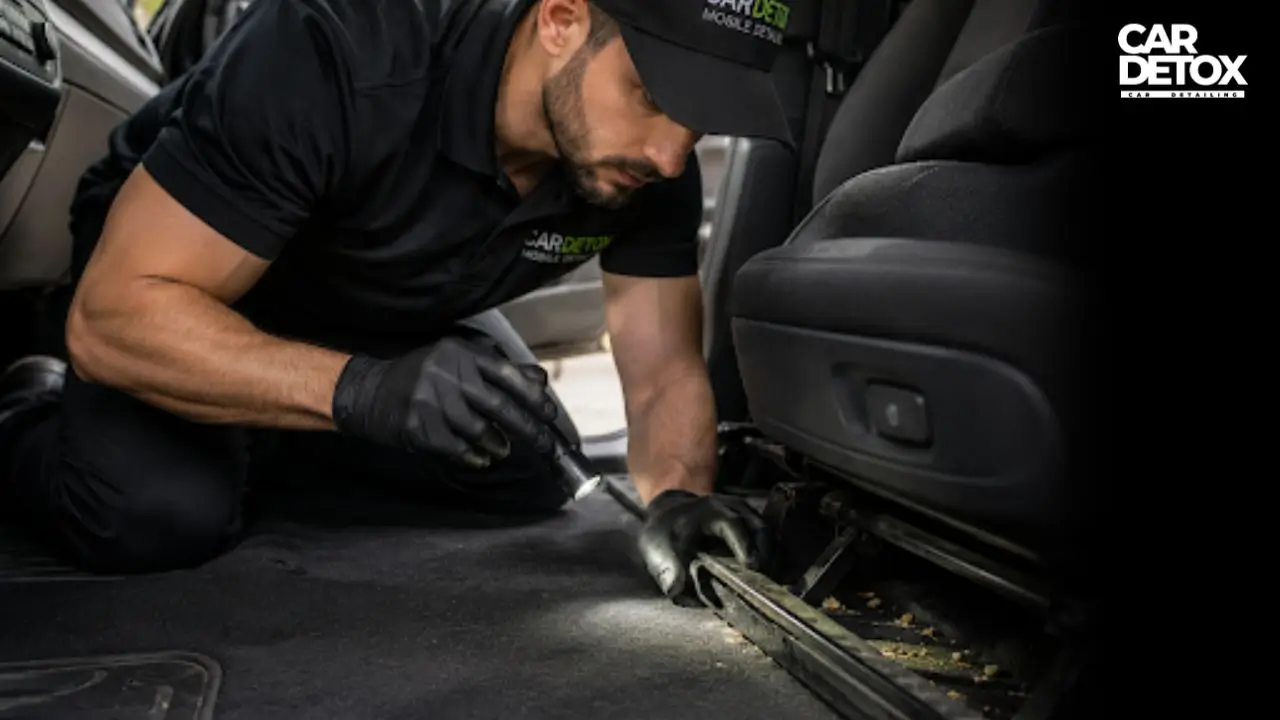
The most important step is finding and removing the food source. If you don’t remove it, odors persist no matter what else you do. Search thoroughly under seats since fries and pieces slip under and decompose there. Check underneath floor mats since moisture and trapped particles create breeding grounds. Look in cup holders where spilled drinks and crumbs accumulate. Wipe door pockets clean since food wrappers get stuffed and forgotten. Check under the driver’s seat rail where food commonly gets lost. Look in air vents since food smell particles can lodge in ventilation. Check seat crevices and between cushions where fries and crumbs hide.
Removal Steps and DIY Solutions
Once you’ve found and removed the source, try these proven methods:
Step-by-Step Removal Process:
- Locate the smell’s strongest point since that’s where the source is hidden
- Vacuum thoroughly under all seats with special attention to carpet edges
- Remove floor mats and shake them out completely to dislodge hidden particles
- Clean cup holders with vacuuming and a damp cloth to remove spill residue
- Wipe door pockets clean with disposable wipes or cloth
- Check under seats with a flashlight for hidden food particles
- Remove and wipe down air vents if accessible and removable
- Use a small handheld vacuum for tight spaces and crevices
- Dispose of all waste immediately in outdoor trash can
- Ventilate the car immediately with windows open
Food Smell Elimination DIY Methods:
- Baking Soda Treatment: Vacuum interior thoroughly, sprinkle baking soda over surfaces, let sit 24-48 hours, vacuum completely. Cost $5, effectiveness 50-70%, best for fresh odors.
- White Vinegar Solution: Mix equal parts vinegar and water, lightly mist surfaces, let dry with windows down. Cost $3, effectiveness 60-75%, best for moderate odors.
- Activated Charcoal: Place bags under seats, leave 3-7 days, replace weekly. Cost $15-25, effectiveness 40-60%, best for ongoing prevention.
- Coffee Grounds: Place fresh grounds in bowls, leave 24-48 hours, replace frequently. Cost $5, effectiveness 30-50%, best for temporary quick fixes.
- Steam Cleaning: Rent cleaner, steam all fabrics, use extraction setting, air dry 24 hours. Cost $50-200, effectiveness 75-85%, best for significant odor problems.
The best approach combines these methods—start with baking soda, follow with vinegar, use charcoal for prevention, and consider steam cleaning if odors persist.
Professional Food Odor Removal: When DIY Isn’t Enough
If DIY methods don’t work after 2-3 weeks, professional services eliminate food odors. Why professional removal works better: hot water extraction removes food particles embedded in padding, enzymatic treatments break down grease and food residue, ozone treatment neutralizes odor molecules at the molecular level, HEPA vacuuming removes microscopic food particles, and complete coverage cleans areas DIY can’t reach.
The professional food odor removal process includes a thorough inspection with a technician locating the smell source, deep vacuuming with a HEPA vacuum removing particles, hot water extraction removing food residue from fabrics, enzymatic application breaking down grease-based smells, optional ozone treatment for stubborn odors, final ventilation to air out completely, and verification confirming odor elimination before finishing. Cost is $200-$400, effectiveness is 95 percent plus food odor elimination, time required is 3-4 hours, and it’s best for persistent odors, grease-based smells, and time-sensitive situations.
Car Detox interior detailing services include food odor removal as part of comprehensive cleaning.
Prevention: Keeping Food Smells Out
Once you’ve eliminated the smell, prevent it from returning. No eating in the car or eat only non-greasy snacks. Keep containers sealed if food must be in the car. Remove trash immediately and don’t leave food wrappers overnight. Use cup holders properly and immediately clean spills. Vacuum regularly, especially weekly if you transport food. Avoid liquid spills since drinks create perfect bacterial growth conditions. Use AC recirculation appropriately and use external air when not needed to bring in fresh outside odors. Do regular dry cleaning. Moisture encourages food odor development.
Simple rule: what you don’t bring in, you don’t have to remove. This philosophy prevents most food odor problems before they start.
Common Mistakes and Misconceptions
Avoid these errors when eliminating food odors:
Major Mistakes to Avoid:
- Spraying fragrance over the smell since this temporarily masks but doesn’t eliminate the source; the food remains, and odor returns stronger
- Using excessive water since oversaturation traps food particles and creates mold conditions
- Leaving floor mats in place during cleaning since underneath is where odors hide most
- Ignoring problem areas since if one spot smells worse, that’s the source; address it specifically
- Procrastinating on action since fresh odors are easier to eliminate than old, set-in smells; act immediately
- Mixing cleaning products since different products create toxic fumes or damage fabric permanently
- Forgetting about the HVAC system since food smell can lodge in air vents and filters; clean or replace
- Using bleach or harsh chemicals since these damage upholstery and aren’t effective on food odors
Common Misconceptions:
- Air fresheners eliminate odor—False, they only mask the smell temporarily
- All odor eliminators work the same—False, effectiveness varies by odor type
- Strong smells are easier to eliminate—False, persistent smells are harder to remove
- One treatment solves the problem—False, combining methods works better
- Expensive products work better—False, basic methods often work as well
- Professional removal is always necessary—False, DIY works for many cases
- You should wait to clean—False, acting fast improves results significantly
FAQ: Food Odor Removal from Cars
Depends on severity—fresh smells fade in 3-7 days with ventilation; stuck odors from old residue persist for weeks or months without treatment.
Yes, diluted vinegar is safe for most fabrics; test on an inconspicuous area first, never oversaturate leather.
No, air fresheners mask smell temporarily but don’t remove the source—the smell returns when freshener fades.
Steam cleaning is fastest and most effective at 3-4 hours; baking soda plus vinegar takes 3-5 days but costs less.
Not always—clean them thoroughly first by washing with hot water, soap, and air drying completely; replace only if smell persists after cleaning.
Yes, if DIY hasn’t worked after 2-3 weeks, $300-$400 is worth reclaiming your car and your peace of mind.
Temporary solution only—they mask smell but don’t eliminate food residue; professional removal is the only permanent fix for stubborn smells.
Leave the car closed overnight, then open it in the morning—if you don’t smell food, it’s gone; no smell after that test equals success.
Eliminate Food Odors Today
Dealing with persistent food smell in your car? Car Detox interior detailing services eliminate food odors with professional hot water extraction and enzymatic treatments. Services include deep hot water extraction, enzymatic food particle removal, ozone odor neutralization if needed, cabin air filter replacement, and final freshness guarantee. Book your food odor removal service for professional results in 3-4 hours, often available the same day in the Portland area.