
Picture a parking lot scenario every Portland driver knows: you return to your car at Bridgeport Village or the Sherwood Fred Meyer and find a fresh door ding. Or it’s spring, an unexpected hailstorm rolled through Tualatin, and your hood now looks like a golf ball. Or you bumped a low concrete pillar in a downtown parking garage and there’s a softball-sized dent in your bumper.
What is paintless dent repair? It’s a specialized technique that removes minor dents, dings, and creases from your vehicle without disturbing the factory paint. Instead of sanding, filling, and repainting (the traditional body shop approach), paintless dent repair uses specialized tools to massage the metal back into shape from behind the panel, preserving the original paint and finish entirely.
In our Tualatin shop, paintless dent repair is one of the most cost-effective ways to restore a vehicle’s appearance and resale value. This guide explains exactly what PDR is, how it works, what it costs, and when it’s the right choice (and when it isn’t).
Key Takeaways
- Paintless dent repair (PDR) fixes minor dents without repainting, preserving the factory finish and saving money
- 80 to 90 percent of typical dents are good candidates for PDR, including door dings, hail damage, and shallow creases
- Costs 25 to 50 percent less than traditional body shop repairs, and most jobs finish same day
- Not suitable when paint is cracked, the dent is on a panel edge, or the metal is stretched or torn
What Is Paintless Dent Repair (PDR)?
Paintless dent repair (PDR) is a technique for removing minor dents, dings, and creases from a vehicle’s body without damaging the original paint. Technicians use specialized tools to gently massage the dent from the inside of the panel, gradually returning the metal to its original shape. Because the paint stays untouched, PDR preserves factory finish, saves money compared to traditional bodywork, and finishes in hours rather than days.
The technique was developed in the 1940s and 1950s by European auto manufacturers (Mercedes-Benz and BMW among them) to fix minor transit damage on new vehicles without redoing the paint. What started as an assembly-line solution became one of the most cost-effective repair methods in modern auto care.
The science behind PDR is straightforward. Metal panels have a property called “memory,” meaning the original shape is the metal’s preferred state. When a dent occurs, the metal is stretched into a new shape, but it still wants to return to its original form. A skilled PDR technician applies controlled pressure from behind the dent to encourage that return, working in small increments until the panel matches the surrounding contour exactly.
PDR works because the paint layer itself is flexible enough to bend with the metal underneath. When the dent occurred, the paint stretched with the panel rather than cracking. Returning the metal to its original shape returns the paint to its original position too. As long as the paint wasn’t broken in the original incident, PDR maintains the factory finish completely.
The result is a repair that’s invisible without close inspection. No paint matching. No body filler. No primer-over-paint problems. Just the original factory finish, restored.
How Does Paintless Dent Repair Actually Work?
The process looks simple from the outside but requires significant skill and specialized equipment. Here’s what happens during a typical PDR session.
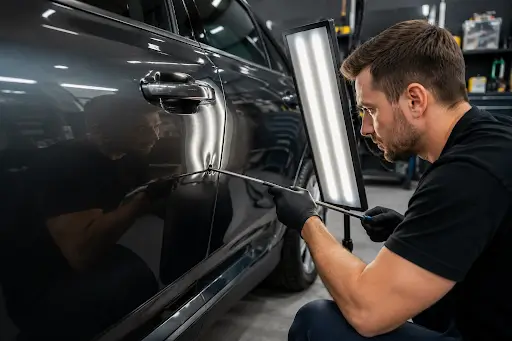
The technician starts with assessment under specialized LED line lighting. These long, striped lights reveal every distortion in a panel’s surface that’s invisible under normal light. A trained eye can see exactly where the high spots and low spots are, which guides the repair strategy. Without this lighting, even experienced technicians work blind.
Next comes access. Most dents are repaired by working from behind the panel, which means the technician may need to remove interior trim, panels, taillight assemblies, or other components to reach the back side of the damage. On door dents, this often means removing the interior door card. On hood or trunk dents, the underside is usually accessible without disassembly. On structural areas with limited access, the technician may use a different technique called glue pulling.
The repair itself uses three main tool categories. The first is metal rods and body picks of various shapes and sizes, which the technician uses to push the dent out from behind. Each push moves a tiny amount of metal, which is why the process requires patience. Tap, push, tap, push, with constant reference to the lighting to track progress. The second is glue pulling, where adhesive tabs are attached to the front of the dent and pulled outward with a slide hammer or pulling tool. This works on dents where back-side access isn’t possible. The third is the “tap-down” tool for pushing down high spots that develop during the repair process.
The work is precise and incremental. A coin-sized dent might take 30 to 60 minutes of methodical work. A hood with hail damage involving 50 to 100 small dents can take a full day. The technician inspects under the lighting after each push to make sure the surface matches the surrounding contour exactly.
After the repair, the panel and any removed trim are reassembled, and the vehicle is ready to go. No drying time, no paint cure, no waiting room delays.
What Types of Dents Can Paintless Dent Repair Fix?
Roughly 80 to 90 percent of typical vehicle dents are good candidates for PDR. The technique works on a wide range of damage when the right conditions are met.
Door dings are the most common PDR repair. Whether they’re from car doors in parking lots, shopping carts at grocery stores, or careless drivers in tight spaces, these small dings (typically 1/4 inch to 2 inches across) are ideal for PDR.
Hail damage is the second major use case. A single hailstorm can leave dozens or hundreds of small dents across hoods, roofs, and trunks. PDR handles each one individually and is the standard approach for hail repair across the industry. Insurance comprehensive coverage typically covers hail damage repair.
Shallow creases from low-impact contact (parking pillars, bicycles, shopping carts) can often be repaired with PDR if the metal isn’t stretched too aggressively and the paint stayed intact.
Pressure dents from objects pressing against the vehicle (a heavy item leaning against a door, a backed-into mailbox) usually respond well to PDR.
The most common locations are hoods, doors, fenders, and side panels because these have accessible backsides and consistent metal thickness. Trunk lids and tailgates also work well.
Dent size matters. PDR generally works on dents from approximately 1/4 inch up to about 4 inches across, sometimes larger depending on the panel and the technician’s skill. Anything bigger than a grapefruit usually needs traditional bodywork.
When Is PDR NOT the Right Choice?
PDR is excellent for the right cases, but there are situations where traditional bodywork is the better call. Honest assessment matters more than trying to force PDR on damage that won’t respond to it.
Cracked or chipped paint. PDR relies on the paint moving with the metal. If the paint cracked or chipped when the dent occurred, restoring the metal won’t restore the paint. The result would be a smooth panel with visible paint damage. These cases need traditional bodywork with sanding, filler, and repainting.
Sharp creases. A sharp, defined crease (rather than a soft dent) often indicates that the metal has been stretched or work-hardened at the crease line. PDR can sometimes improve these but rarely eliminates them completely. Traditional repair is more reliable.
Edge damage. Dents on the very edge of a panel (door edges, hood edges, trunk lid edges) are difficult to access from behind and often involve metal that’s already work-hardened from the panel-stamping process. PDR success rates drop significantly on edges.
Stretched or torn metal. A high-impact dent that stretched the metal beyond its memory limit can’t return to its original shape. Same for any tear in the metal. These require panel replacement.
Dents on aluminum panels can sometimes be repaired with PDR but require specialized technique because aluminum doesn’t have the same memory as steel. Hood, fender, and door panels on some modern vehicles (Ford F-150, many luxury cars) are aluminum. Discuss with your technician before assuming PDR will work.
Areas with reinforcement bracing behind the panel. Some panels have crash bars, reinforcement structures, or sound-deadening foam directly behind the dent area, making access impossible. These need traditional repair.
A good PDR shop will tell you honestly when PDR isn’t the right choice. At Car Detox, we offer a free consultation so you know upfront whether PDR fits your specific damage before committing to the work.
How Much Does Paintless Dent Repair Cost?
Costs vary based on dent size, location, accessibility, and quantity. Here are realistic ranges for the Portland metro market.
A single small door ding (dime to quarter sized) typically runs $75 to $150. A larger single dent (golf ball to softball sized) runs $150 to $400 depending on location and depth. Multiple dents on the same panel often have package pricing rather than per-dent costs.
Hail damage repair is priced differently because it involves dozens or hundreds of small dents across multiple panels. Insurance claims for hail damage often range from $1,500 to $8,000 depending on storm severity and vehicle size. The good news is comprehensive coverage typically covers hail damage with no fault assigned to the driver.
For comparison, traditional body shop repair of a single door ding runs $300 to $700 minimum because of sanding, primer, paint matching, and clear coat application. A PDR repair of the same ding at $100 to $150 represents real savings. Across larger jobs the savings scale similarly, with PDR running 25 to 50 percent less than traditional bodywork for the same damage.
A few factors increase PDR cost. Panels requiring trim or assembly removal take more labor. Aluminum panels need specialized technique and add to the quote. Dents in difficult access areas (close to body lines, edge of panels) increase time required. Multiple dents in different locations add up because each one requires positioning and technique work.
Free consultations matter here. Without seeing the damage in person and under proper lighting, no honest technician can give you a firm quote. The Car Detox PDR consultation takes 15 to 30 minutes and gives you a flat quote for the work before you commit.
Got a dent or hail damage? Book a free PDR consultation at Car Detox and we’ll assess your specific situation.
How Long Does Paintless Dent Repair Take?
Most PDR jobs finish dramatically faster than traditional bodywork. Single small dents take 30 to 60 minutes. Larger single dents take 1 to 3 hours. Multiple dents on the same panel might take 2 to 5 hours depending on quantity and complexity.
Hail damage is the exception. A vehicle with significant hail damage across multiple panels can take 1 to 3 days of methodical work. Each individual dent still gets the same careful attention, but there are simply more of them to address.
For comparison, traditional body shop repair of a single door ding typically takes 3 to 5 business days because of paint cure time, multiple coats, and matching to existing finish. PDR on the same damage finishes in an afternoon, with no overnight wait.
This time difference matters for daily drivers, leased vehicles approaching turn-in, and anyone who can’t be without their car for several days. PDR usually means drop off in the morning, pick up that afternoon.
What Are the Benefits of Paintless Dent Repair?
The cost savings get the most attention, but PDR has six core benefits that make it the preferred choice when it’s an option.
Preserves factory paint. The original manufacturer paint job, with its specific formulation, application, and curing process, is the highest-quality finish your vehicle will ever have. Traditional bodywork can match the color but rarely matches the depth, durability, or longevity of OEM paint. PDR keeps the original finish entirely intact.
Retains resale value. Vehicle history reports and Carfax records often note major paint or body work. PDR repairs don’t usually appear because they didn’t involve paint or filler. The vehicle’s history stays cleaner, which preserves trade-in and private sale value.
Affordable compared to traditional bodywork. The 25 to 50 percent cost savings adds up significantly across multiple repairs or hail damage cases.
Fast turnaround. Same-day service for most repairs means no rental car costs and no transportation logistics.
Eco-friendly. No solvents, no paint runoff, no waste generated by traditional bodywork. PDR has a meaningfully smaller environmental footprint.
Works with modern paints. Modern factory paints are durable enough to bend with the metal during PDR repair. The technique works as well today as it did when developed, with no significant limitations on contemporary vehicles.
For Portland drivers, an additional benefit is the seasonal fit. Spring hail events, parking lot dings during busy holiday shopping seasons, and minor incidents during ski trips to Mt. Hood all create PDR-candidate damage. Quick, affordable repair keeps the vehicle looking its best year-round.
After PDR repair, the natural next step is paint protection. A ceramic coating applied to the repaired panel (or the entire vehicle) preserves the now-perfect finish and prevents future minor damage from chemical etching, water spots, and UV fade.
Can PDR Fix Hail Damage?
Yes, and hail damage repair is one of PDR’s strongest use cases. Insurance companies overwhelmingly prefer PDR for hail claims because it costs less than traditional repair and produces better results.
When hail strikes, the impact is usually spread across multiple panels with dozens of small dents per panel. A hood might have 30 dents. A roof, 50. A trunk, 20. Traditional repair would require sanding and repainting every affected panel, which is both expensive and time-consuming. PDR addresses each dent individually while preserving the factory finish across the entire vehicle.
The insurance process is typically straightforward. After a hail event, file a comprehensive claim with your insurer. They’ll request photos or send an adjuster to assess damage. Most insurers approve PDR repair as the standard solution and may have preferred PDR shops in their network. Many policies have a deductible for comprehensive claims (often $500 to $1,000), which is the only out-of-pocket cost for most owners.
For Oregon drivers, hail events are most common in spring and occasionally fall. The Portland metro doesn’t see hail as frequently as Denver or the Midwest, but it does happen, and the vehicles affected need quick repair to prevent rust formation at any spots where paint cracked during the hail strike.
If you’re dealing with hail damage, document the damage with photos before any repair work begins. Bring the photos to your free consultation so the technician can plan the repair scope efficiently.
Should You Try DIY Paintless Dent Repair?
You can find DIY PDR kits at auto parts stores for $50 to $200. They include suction tools, glue tabs, and basic pulling devices. Honest answer: they almost never produce professional-quality results.
PDR is a learned skill that takes most professional technicians 2 to 5 years to develop competency, with another 5+ years to reach expert level. The visual judgment required to read panel distortion under LED lighting is something that develops only with hours of repetitive practice. The hand-eye coordination to push exactly the right amount in exactly the right place takes longer still.
DIY kits also lack the proper tools for professional work. Real PDR uses dozens of specialized rods, picks, and tap-down tools sized for specific situations. DIY kits include 3 to 5 basic tools. The difference shows up in the result.
The most common DIY outcomes we see at our shop are partial repairs (the dent is improved but visible), worsening dents (the metal was pushed too aggressively in one spot, creating a new high spot), and stretched metal (overworking the area to the point where PDR can no longer return it to original shape). The last outcome means the only remaining option is traditional bodywork at full cost.
If the dent is on a junker car you don’t care about, DIY is harmless to try. For any vehicle where appearance and value matter, professional PDR is the right call from the start. The cost difference between a DIY attempt and professional service is typically less than the value lost from a failed DIY repair.
What Mistakes Should You Avoid?
- Waiting too long to repair. Dents can develop rust at any point where paint cracked or thinned. Address damage within weeks, not months
- Trying DIY kits on visible panels. Failed DIY repairs often leave permanent damage that increases the eventual repair cost
- Choosing the cheapest PDR quote without evaluating quality. Skill matters more than price. Look for certified technicians and ask about training
- Skipping the free consultation. Without seeing the damage under proper lighting, no honest quote is possible
- Forgetting to coordinate with insurance for hail damage. Comprehensive coverage often pays for the entire repair minus deductible
- Not following up with paint protection. Once the panel is restored, ceramic coating prevents new damage from chemical, UV, and water-spot exposure
Frequently Asked Questions
What is paintless dent repair?
A technique to remove dents without damaging factory paint, using specialized tools to massage the metal back into shape from behind.
Does PDR work on all dents?
Roughly 80 to 90 percent of typical dents are good candidates. Cracked paint, sharp creases, and stretched metal usually require traditional bodywork.
How much does paintless dent repair cost?
Single small dings start around $75 to $150. Larger dents run $150 to $400. Hail damage claims typically range $1,500 to $8,000.
How long does PDR take?
Most jobs finish the same day. Small dents in 30 to 60 minutes, larger dents in 1 to 3 hours, hail damage in 1 to 3 days.
Does insurance cover PDR?
Yes for hail damage under comprehensive coverage. Not covered for minor cosmetic damage that doesn’t meet the deductible.
Will PDR damage my paint?
No, when done by a qualified technician. The whole point of PDR is preserving the original factory finish.
Can hail damage be fixed with PDR? Yes. Hail damage is one of the strongest use cases for PDR, and most insurance companies prefer it for hail claims.
Is PDR cheaper than traditional bodywork?
Yes. PDR typically costs 25 to 50 percent less than traditional body shop repair for the same damage.
How do I know if my dent qualifies for PDR?
Book a free consultation. Technicians can assess size, location, paint condition, and accessibility to determine if PDR will work.
Should I get paint protection after PDR?
Yes. Ceramic coating after dent repair preserves the restored finish and prevents future minor damage.
Final Thoughts
What is paintless dent repair? It’s the smartest way to fix minor dents on most vehicles when the paint stays intact. For 80 to 90 percent of typical dents (door dings, hail damage, shallow creases, parking lot bumps), PDR preserves factory paint, saves significant money compared to traditional bodywork, and finishes in hours rather than days.
The right answer for any specific dent depends on size, location, paint condition, and accessibility. The best path forward is a free professional consultation that tells you honestly whether PDR will work for your situation and what it will cost.
If you have a door ding, hail damage, or any minor body damage in the Portland metro, book a free paintless dent repair consultation at Car Detox at our Tualatin shop. We serve Beaverton, Tigard, Lake Oswego, Sherwood, West Linn, and the broader Portland metro.