
Oregon legalized recreational cannabis in 2014, and Portland metro has been one of the highest-use markets in the country ever since. That comes with a practical consequence most owners don’t think about until they’re trying to sell their car: cannabis smoke leaves a stronger, more persistent smell in vehicle interiors than tobacco.
How to get weed smell out of your car is a different problem than removing cigarette smoke. Cannabis residue is oilier, more terpene-rich, and bonds more aggressively to upholstery, headliner, and cabin air filters. Air fresheners don’t touch it. Wiping down surfaces barely helps. The smell often returns within hours of any quick fix attempt.
In our Tualatin shop, we treat cannabis odor in vehicles every week, from teenager hand-me-downs to recently purchased used cars from private sellers. This guide explains why weed smell sticks, what actually works to remove it, and when to skip DIY and book a professional smoke smell removal service.
Key Takeaways
- Cannabis residue is oilier than cigarette tar and bonds more aggressively to fabric, headliner, and HVAC ducts
- Air fresheners mask but never remove the smell. The underlying residue continues to off-gas indefinitely
- Heavy weed smell typically requires professional deep clean plus ozone treatment ($300 to $500)
- For light cases, steam cleaning, ventilation, and activated charcoal can handle the problem at home
What’s the Best Way to Get Weed Smell Out of a Car?
The best way to get weed smell out of a car is a two-step process: deep clean every porous surface to remove the cannabis residue, then neutralize remaining airborne molecules with ozone treatment. Light cases respond to thorough vacuuming, steam cleaning, vinegar wipe-down, and a fresh cabin air filter. Heavy cases (regular smoking, hotboxing, or older used vehicles) need professional treatment because residue penetrates headliner foam, seat padding, and HVAC ducts where DIY can’t reach.
The reason most odor remediation efforts fail is they target the wrong thing. Spraying air freshener, hanging Little Trees, or running the car with windows down dilutes the airborne smell temporarily. None of those approaches remove the residue source. The moment the freshener wears off or you close the windows, the smell returns at full strength because the cannabis compounds are still embedded in the fabric, foam, and ducts.
The right approach addresses the source first, then the residual molecules. Physical removal through steam and cleaning lifts the cannabis residue from porous surfaces. Chemical oxidation through ozone breaks down what physical cleaning can’t reach. Together, these two steps eliminate the smell rather than masking it.
For light cases (one or two smoking sessions, recent), DIY can handle it. For anything heavier, the math favors professional service because half-measures don’t deliver lasting results.
Why Is Weed Smell Harder to Remove Than Cigarette Smoke?
Cigarette smoke and cannabis smoke leave different residue chemistries, and the differences matter for cleaning.
Cannabis contains aromatic compounds called terpenes (specifically limonene, pinene, myrcene, and beta-caryophyllene among others) that bond more aggressively to porous surfaces than tobacco compounds. Terpenes are oily, sticky molecules that the cannabis plant produces partly to defend itself from predators. The same chemistry that makes them effective plant defenses also makes them stubborn cabin residue.
Combustion adds another layer. When cannabis burns, it releases cannabinoid oils (THC, CBD, and dozens of minor cannabinoids) along with the terpenes. These oils don’t dissolve in water-based cleaners, which is why most household sprays fail against the smell. They need either solvent-based removal or oxidation to break down completely.
Cigarette residue, by contrast, is primarily tar particles, nicotine, and combustion byproducts. Tar is sticky but responds well to standard automotive cleaners. Nicotine is a polar compound that water-based products can address. The whole residue profile is more cooperative with conventional cleaning.
The practical result is that a 4-hour interior detail that resolves cigarette smell on a moderate smoker car might only partially address cannabis smell from the same usage level. Cannabis odor often requires an additional ozone treatment stage to fully eliminate. This is why professional shops charge slightly more for cannabis odor remediation than for cigarette smell removal on equivalent vehicles.
The smell also tends to linger 24 to 72 hours longer in a vehicle without cleaning, which means routine smoking creates a baseline odor that never fully dissipates between sessions.
How Does Cannabis Smoke Damage Your Car Interior?
Cannabis smoke doesn’t just smell. It physically contaminates multiple parts of your cabin in ways that affect the vehicle long after the smell is gone.
The headliner is usually the worst-hit area. Cannabis smoke rises directly to the cabin ceiling and accumulates in the headliner fabric. The terpenes and oils bond to the fabric fibers and seep into the foam underneath. Many used cars from regular smokers show yellow-brown discoloration on the headliner that won’t fully clean even with professional treatment.
The upholstery absorbs cannabis residue across every fabric surface. Cloth seats hold it more than leather, but even leather seats with fabric inserts accumulate odor in stitched seams. Floor mats, trunk liners, and cargo carpets all contribute to the cumulative smell.
The HVAC system is where most owners don’t think to look. Every time you turn on heating or air conditioning, the system pulls air through the cabin and across the cabin air filter. Cannabis residue accumulates on the filter, in the ducts, and in the blower fan housing. Even after a perfect interior cleaning, an untreated HVAC system will reintroduce smell every time the AC runs.
The cabin air filter becomes saturated with cannabis particles. Filters that haven’t been replaced in 12 to 18 months in a smoker’s vehicle are essentially a sponge full of residue. Replacing the filter is one of the most important steps in any odor remediation.
The dashboard, door panels, and console plastics collect a thin oily film from cannabis smoke that’s invisible until you wipe it with a microfiber. The film attracts dust, which then sticks more than usual, accelerating cabin contamination across the year.
For owners considering selling or trading the vehicle, this cumulative damage affects resale value. Cannabis-smelling vehicles often appraise $1,500 to $3,000 below comparable clean vehicles. Buyers and dealers spot the smell immediately and price accordingly.
What DIY Methods Actually Work for Light Weed Smell?
For mild cases (one or two recent smoking sessions, no daily use), several DIY methods can handle the problem at home.
Start with aggressive ventilation. Park in dry weather, open all doors and windows, and let the cabin air out for at least an hour. This removes most of the airborne smell, though it won’t touch the residue sources. Run interior fans through the cabin if you have any available.
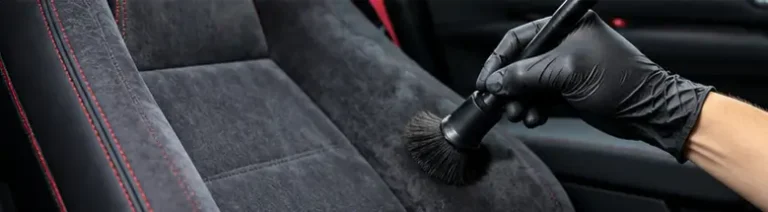
Vacuum thoroughly. Every fabric surface, between seats, under floor mats, in cargo zones. Cannabis particles settle into every crevice, and vacuum removal addresses the loose residue before it bonds further. Pay special attention to the area around the driver’s seat where most smoking happens.
Wipe hard surfaces with a 50/50 mix of distilled white vinegar and warm water. Apply to a microfiber, then wipe the dashboard, console, door panels, plastic trim, and interior glass. Vinegar’s mild acidity neutralizes some terpene compounds without damaging plastic or trim. Avoid using vinegar on leather, as it can dry the material with repeated application.
Sprinkle baking soda on cloth seats and carpet. Leave it overnight, then vacuum the next day. Baking soda absorbs surface odor molecules from fabric. Repeat 2 or 3 times if the smell persists.
Place 3 to 5 activated charcoal bags throughout the cabin for 48 to 72 hours. Charcoal is more effective than baking soda for ongoing absorption and works passively without needing to be applied to surfaces. Replace bags as odor persists.
Replace the cabin air filter. This is the single highest-ROI DIY step. A $20 to $40 filter replacement removes a major source of recurring smell, since saturated filters spread cannabis residue every time the HVAC runs.
If the smell is still present after this protocol, you’re past the DIY threshold. Professional treatment is the right next step.
Dealing with weed smell that won’t go away? Book smoke smell removal at Car Detox and we’ll quote based on actual severity.
Why Do DIY Methods Fail on Heavy Cases?
For vehicles with daily smoking, hotbox sessions, or used cars from regular smokers, DIY methods consistently fall short. Three specific reasons explain why.
First, the residue lives in places DIY can’t reach. Cannabis oils penetrate the foam layer underneath upholstery fabric, accumulate inside HVAC ducts where no household tool can clean, and bond to headliner foam in ways that surface cleaning won’t address. You can clean the visible surfaces perfectly and still have the smell return within 48 hours because the source is still present underneath.
Second, the cleaning chemistry needed is professional-grade. Water-based household cleaners don’t dissolve cannabinoid oils effectively. Solvent-based cleaners that would work are often unsafe for interior fabrics or require equipment most homes don’t have. Professional shops use commercial-grade cleaners formulated specifically for cannabis residue.
Third, ozone is required for thorough remediation. Commercial ozone generators flood the cabin with O3, which chemically oxidizes the residual odor molecules at the molecular level. The treatment runs for 8 to 24 hours depending on severity. Consumer ozone machines either don’t have enough output to treat a vehicle volume effectively, or they run uncontrolled concentrations that can damage interior materials. Professional treatment uses calibrated commercial units in controlled conditions.
The other failure mode we see at our shop is well-intentioned DIY that makes the problem worse. Spraying cologne, hanging multiple air fresheners, or applying scented sprays combines with cannabis residue to create a new layered odor that’s harder to remove than the original smell. Some owners come in with cars that smell worse than they would have from straight cannabis alone because of layered masking attempts.
For these cases, the $300 to $500 investment in professional treatment is dramatically more cost-effective than continued DIY attempts that don’t deliver lasting results.
How Does Professional Weed Smell Removal Work?
The professional process for cannabis odor remediation is a multi-step protocol designed to address every contamination point in the vehicle.
It starts with full inspection and documentation. We assess severity, identify any visible damage (yellow-brown discoloration on headliner, oily film on dashboard, saturated cabin air filter), and quote the work based on actual condition.
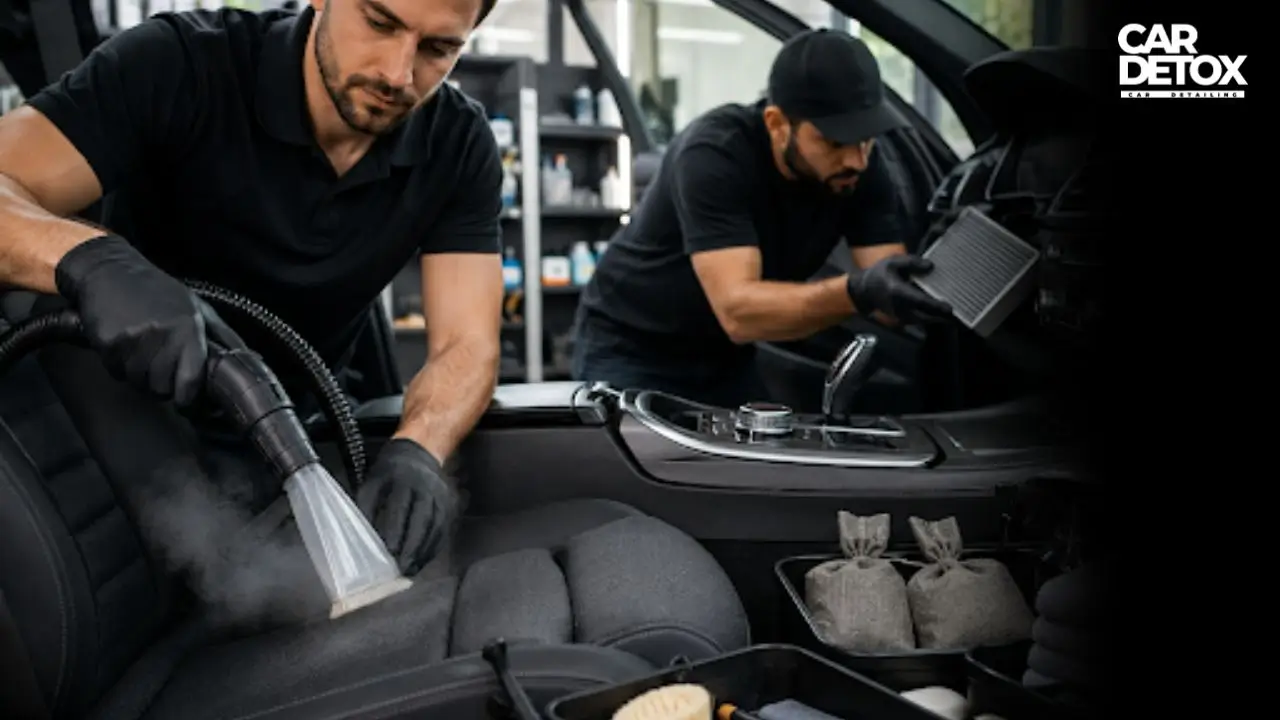
The first cleaning stage is a complete interior detail. Steam cleans every fabric surface including seats, carpets, headliner, and floor mats. Commercial solvent wipe of all hard surfaces including dashboard, console, door panels, vents, and shifter boots. Vacuum every crevice with high-suction equipment. Replace the cabin air filter with a fresh unit.
The second stage addresses the HVAC system specifically. We run a cleaning solution through the AC ducts to reach surfaces the interior cleaning can’t access. This step is critical because untreated ducts will reintroduce smell every time the AC runs after the rest of the interior is clean.
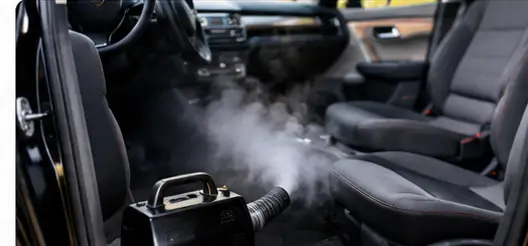
The third stage is ozone treatment. We seal the cabin completely (all vents closed, doors latched, windows up) and run a commercial ozone generator inside for 8 to 24 hours depending on severity. The ozone fills the cabin and oxidizes remaining odor molecules in every porous surface including the foam padding under upholstery. This is the step DIY cannot replicate.
After ozone treatment, we ventilate the vehicle for 30 to 60 minutes to allow residual ozone to break down into oxygen. The cabin is then inspected and sniff-tested to verify complete odor removal. For severe cases (heavy daily smoking over years), we may run a second ozone cycle.
Total turnaround is typically 1 to 2 days depending on severity. The vehicle is ready to drive with no cannabis smell when picked up.
How Much Does Professional Cannabis Odor Removal Cost in Portland?
Pricing depends on severity, vehicle size, and how long the smell has been present.
Light cases (occasional smoking, recent, mild smell) run $275 to $350 with a deep interior clean and shorter ozone cycle. Moderate cases (regular but not daily smoking, established smell) run $350 to $450 with the full interior plus 8 to 12 hours of ozone. Heavy cases (daily smoking for months, hotboxing, vehicles from long-term smokers) run $450 to $550 with 18 to 24 hours of ozone. Severe cases (multiple smokers, vape combined with cannabis, multi-year exposure) may require two-cycle treatment at $550 to $700.
For comparison, the regional Portland market for cannabis odor remediation runs $250 to $700 across various shops. Car Detox pricing sits in the mid range while using commercial-grade ozone equipment and a more thorough multi-step cleaning protocol than many competitors.
If the vehicle also has mold concerns (common when cannabis residue combines with PNW humidity or wet pet incidents), mold treatment is a separate add-on at $300 to $700. The two services together address the most stubborn cabin contamination cases.
Free consultations help establish severity and quote accurately. Without seeing the vehicle, no honest detailer can give a firm price for cannabis odor removal because the severity range is so wide.
Can You Hide a Weed Smell Before Selling a Used Car?
The honest answer is no, not reliably. Buyers and dealers detect cannabis smell within 30 seconds of opening a vehicle door, and masking attempts often make detection easier rather than harder.
The most common mistake sellers make is applying multiple air fresheners just before showings. The fresh, almost overpowering air freshener scent on a used vehicle is itself a signal that something is being hidden. Experienced buyers and every dealer trade-in inspector treats heavy air freshener as a yellow flag worth investigating.
The same applies to spray cologne, Febreze, dryer sheets, and other masking products. They cover the smell for 1 to 4 hours, but the underlying residue continues to off-gas. By the time the buyer takes possession and drives the vehicle home, the smell becomes obvious. This creates buyer’s remorse, demand for partial refunds, or in worst cases, legal disputes over undisclosed conditions.
The reliable approach for sellers is to remediate honestly. Book professional cannabis odor removal 1 to 2 weeks before listing the vehicle. Replace the cabin air filter. Provide receipt documentation showing the work was completed.
The investment typically pays back many times in retained resale value. A cannabis-smelling vehicle commonly trades at $1,500 to $3,000 below comparable clean vehicles. A $400 professional treatment that recovers that value differential is the highest-ROI move you can make before selling.
For lease returns, the math is similar. Lease-end inspectors note smoke odor as a wear-and-tear issue triggering fees that often exceed the cost of remediation. Honest cleanup beats inspection fees.
How Do You Prevent Weed Smell From Returning?
If you continue to use cannabis after odor remediation, the smell will return. There’s no permanent fix that survives ongoing exposure. That said, several habits dramatically reduce odor buildup if you continue to smoke or transport cannabis.
The single most effective prevention is to not smoke in the vehicle. Stepping outside before consuming, even at home, prevents 90 percent of the cabin contamination that creates the smell in the first place. For Portland metro drivers especially, the legal risk of smoking while driving is real (Oregon’s open container laws apply to cannabis), and the cabin contamination it causes affects vehicle value year after year.
If you must transport cannabis, use airtight containers. Sealed glass jars, vacuum-sealed bags, and odor-proof storage bags (commonly marketed for cannabis use) all prevent passive odor migration during transport. Open bags or pockets are how casual transport leads to lingering smell.
Keep your cabin air filter on a regular replacement schedule. Annual replacement at minimum, more often for cars carrying cannabis frequently. A clean filter prevents residual particles from circulating through the HVAC every drive.
Vacuum monthly and wipe surfaces with a damp microfiber to prevent residue buildup before it bonds permanently. Surface contamination is much easier to remove than embedded contamination.
For rideshare drivers transporting cannabis-using passengers, a monthly Car Detox detailing membership keeps the cabin presentable enough to maintain 4.8+ ratings on Uber and Lyft without daily cleaning effort on your part.
What Mistakes Should You Avoid?
- Spraying cologne or perfume over the smell. Combines with cannabis residue to create a worse, layered odor that’s harder to remove than the original
- Hanging multiple Little Trees air fresheners. Looks suspicious to buyers and inspectors, and the chemistry often clashes with cannabis residue
- Skipping the cabin air filter replacement. A saturated filter reintroduces smell every time the AC runs, making other cleaning efforts pointless
- Doing ozone without cleaning first. Ozone destroys airborne molecules but doesn’t remove the residue source. Always deep-clean before ozone treatment
- Using consumer ozone machines. Most are too weak to treat vehicle volume effectively, and uncontrolled concentrations can damage interior materials
- Driving immediately after professional ozone treatment. Always ventilate 30 to 60 minutes first, or you’ll get eye and throat irritation from residual ozone
- Continuing to smoke in the car after professional treatment. Brings the smell back immediately and wastes the remediation investment
Frequently Asked Questions
How do you get the smell of weed out of a car? Deep clean every surface, replace the cabin air filter, then run an ozone treatment to neutralize remaining molecules.
Does Febreze work on weed smell? For mild cases, partially. For heavy odor, no. It masks for hours then the smell returns from the residue source.
Why does weed smell stay in cars longer than cigarettes? Cannabis produces oilier, terpene-rich residue that bonds more aggressively to upholstery and porous surfaces than tobacco compounds.
Can professional detailing fully remove weed smell? Yes, with combined deep cleaning and ozone treatment. DIY usually can’t reach the residue inside HVAC ducts and seat foam.
How much does professional weed smell removal cost in Portland? $275 to $550 for most cases, up to $700 for severe multi-smoker vehicles.
Will the smell come back after treatment? Not if the source is fully treated. Continued smoking in the car brings it back immediately.
Does weed smell affect car resale value? Yes, typically by $1,500 to $3,000 below comparable clean vehicles.
Can I do ozone treatment myself? Consumer machines are usually too weak. Professional treatment is more cost-effective and produces lasting results.
How long does treatment take? 1 to 2 days for moderate cases, up to 3 days for severe cases requiring two ozone cycles.
Is ozone safe for car interiors? Yes when applied at controlled concentrations by professionals. DIY consumer machines running too long can dry materials.
Final Thoughts
How to get weed smell out of your car comes down to two principles: remove the residue source completely, then neutralize the remaining airborne molecules. Light cases respond to thorough DIY with ventilation, steam cleaning, vinegar wipe-down, cabin filter replacement, and activated charcoal. Heavy or persistent cases need professional deep cleaning combined with ozone treatment.
For Oregon drivers, this is a more common issue than in non-legal states, and the chemistry of cannabis residue makes it genuinely harder to remove than cigarette smoke. The right approach saves your cabin from permanent contamination and protects your resale value.
If your car has cannabis odor that won’t quit, book smoke smell removal at Car Detox at our Tualatin shop. We treat cannabis odor differently from cigarette smoke and will quote your vehicle based on actual severity. We serve Beaverton, Tigard, Lake Oswego, Sherwood, West Linn, and the broader Portland metro.