
Portland is one of the best cities in America to own an electric vehicle. Oregon ranks 4th in the nation for EV adoption, with more than 100,000 registered electric vehicles on state roads, and that number continues to grow. Tesla Model 3s, Model Ys, and Rivian R1Ts are common everywhere from the Pearl District to Lake Oswego.
Here’s what most EV owners don’t know: your electric vehicle needs to be detailed differently from a gas-powered car. Not more often and not necessarily more expensively. Just differently, because EVs are built differently.
This guide covers exactly what changes with EV car detailing, what stays the same, and how Portland EV owners can protect their investment in a climate that presents its own unique challenges.
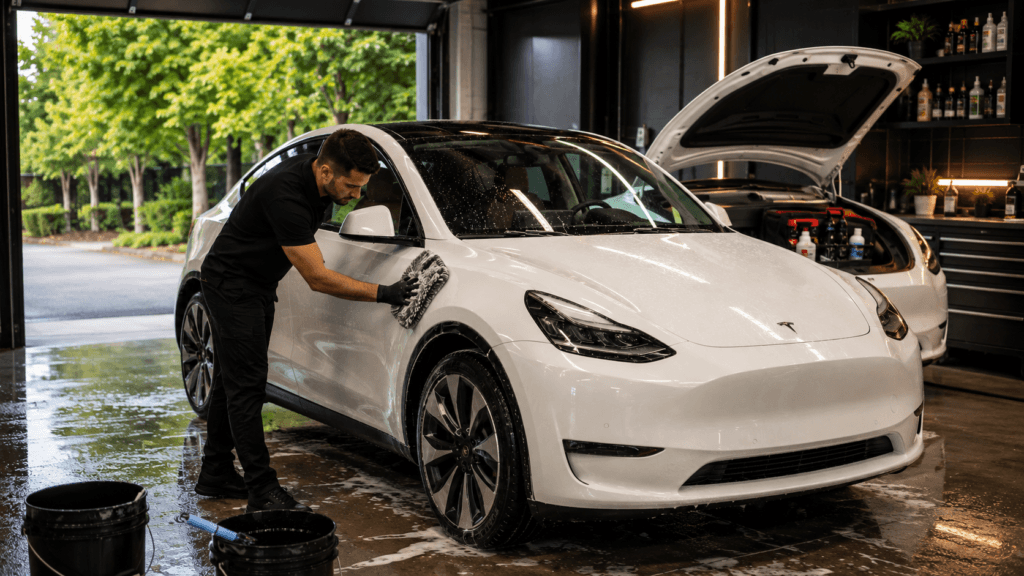
Why EV Car Detailing Is Different
Let’s start with the honest answer most detailing guides skip.
An electric vehicle is fundamentally different in construction from a gas-powered car. There’s no combustion engine, no exhaust system, no oil residue, and no radiator grime. But in their place are high-voltage battery packs, advanced sensor arrays, sealed electrical systems, large panoramic glass roofs, frunks, charge ports, and paint systems that don’t always behave like traditional automotive clear coat.
Getting any of these wrong isn’t just a cosmetic issue. Incorrect products or excessive pressure on sensor housings can affect your ADAS safety systems. Harsh chemicals on touchscreens can damage anti-glare coatings. Aggressive pressure washing near sealed battery components can introduce water risks to electronic components. Using abrasive wash techniques on EV paint, especially Tesla vehicles, can also create swirl marks faster than on many gas-powered cars.
Here’s what every Portland EV owner needs to know before their next detail.
EV Paint — Softer Than You Think
This is the most important thing to understand about EV car detailing — and the one most people learn the hard way.
Tesla vehicles in particular are well-documented in the detailing community for having a notably soft, thin clear coat compared to many European and Japanese gas cars. Several other EV manufacturers share this characteristic as part of eco-conscious, lighter-weight paint systems designed to reduce vehicle weight and emissions in the manufacturing process.
Soft clear coat means:
- Swirl marks appear faster and more visibly than on harder paint
- Automatic car washes cause more damage per visit
- Even improper hand wash technique with a dirty mitt creates visible scratches
- The paint shows water spots more readily — a real issue with Portland’s mineral-rich water supply
What this means for your detailing routine:
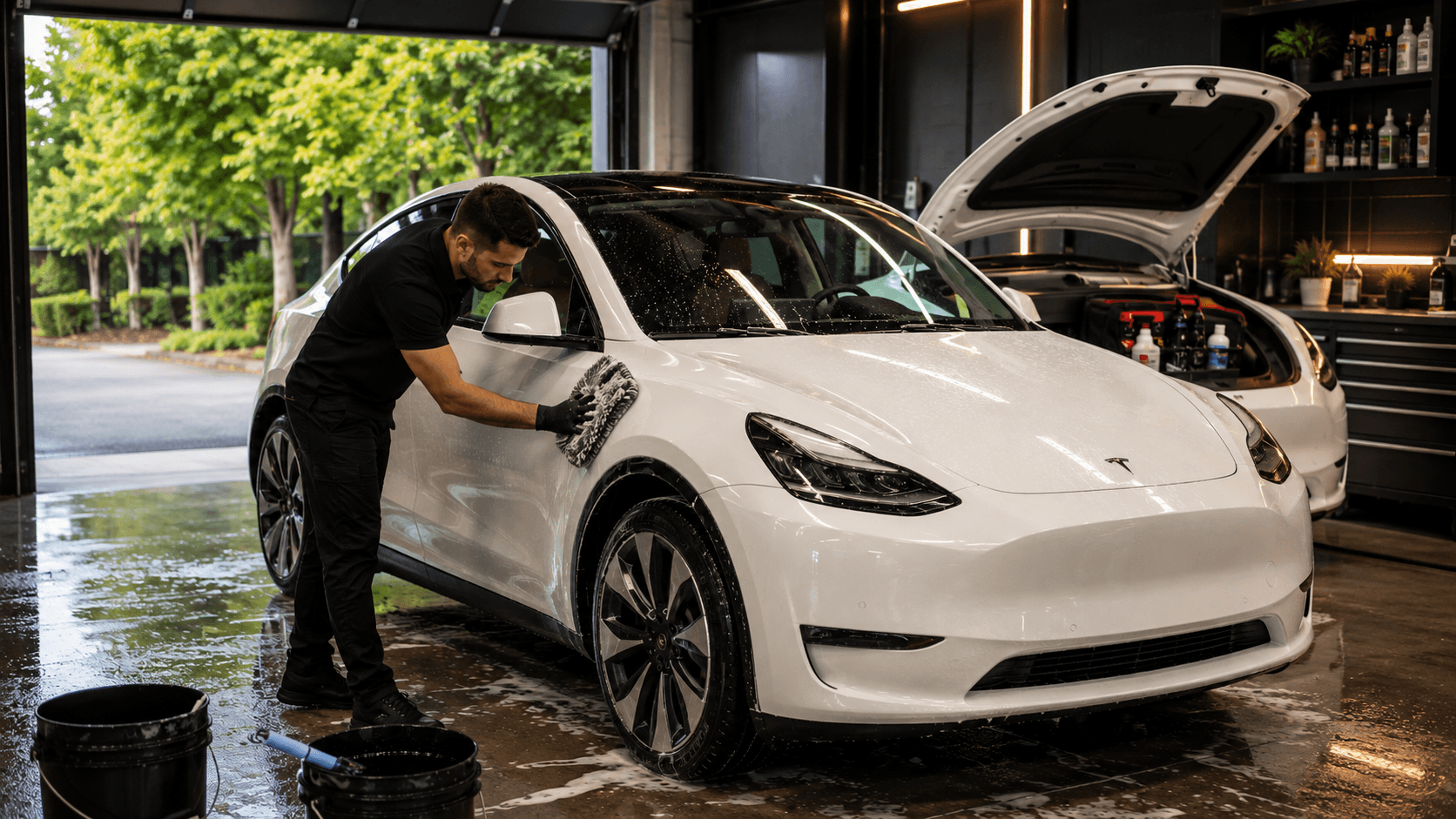
- Always use the two-bucket hand wash method. Use one bucket with pH-balanced shampoo and one clean rinse bucket.
- Use fresh, clean microfiber wash mitts. Never reuse a mitt that has touched the ground.
- Dry with a high-pile microfiber drying towel immediately. Never let water air dry on EV paint.
- Consider ceramic coating to add a hard, protective layer over your EV’s softer clear coat.
Our Tesla ceramic coating service and ceramic coating for Rivian are specifically designed for EV paint systems — providing a durable barrier that makes future cleaning safer and easier for years.
EV-Specific Detailing Areas — What Gas Cars Don’t Have
The Frunk
Every front-opening EV has a frunk, which is a front trunk where the engine bay used to be. On a Tesla Model Y or Rivian R1T, this is a functional storage space that many owners use regularly for groceries, gear, and valuables.
Here’s what most detailers miss: frunks collect dirt, debris, and moisture just like a regular trunk, but many owners never clean them. Over time, organic debris and moisture in Portland’s rainy climate can cause musty smells, mold growth, and staining in frunk liners.
Cleaning the frunk properly requires the same interior-grade products used on carpet and plastic, not the engine degreasers used in traditional engine bay cleaning. At CarDetox , we treat the frunk as an interior surface, not an engine compartment.
The Glass Roof
Tesla Model 3, Model Y, Cybertruck, and Rivian R1S and R1T all feature large panoramic glass roofs. These are stunning, but they present a specific detailing challenge.
Glass roofs accumulate the same grime as any exterior surface but require ammonia-free glass cleaner to avoid degrading the UV-tinted coating bonded to the glass. Standard glass cleaners containing ammonia, including many household window sprays, can gradually cloud and streak the tint layer on glass roofs over time.
Use an ammonia-free automotive glass cleaner and a clean, dedicated microfiber cloth. Never use paper towels on glass roofs. Paper pulp can cause fine scratches. On the interior side, the glass roof can collect fingertip grease and condensation, so wipe it with a lightly dampened ammonia-free cloth only.
The Charge Port
Your EV’s charge port opens multiple times per week and is exposed to Portland’s rain, dust, pollen, and road spray constantly. Most EV owners never clean it.
A neglected charge port accumulates debris that can affect charging contact quality over time. Use a dry detailing brush or compressed air to gently clean the port housing and surrounding area. Never spray water directly into an open charge port. Never use liquid cleaners inside the port itself. Wipe the exterior housing with a lightly dampened microfiber cloth.
Aero Wheel Covers
Most EVs, including the Tesla Model 3 and Model Y, come with plastic aero covers over the alloy wheels to reduce drag and extend range. These covers can trap dirt and brake dust behind them and require removal for proper cleaning.
Most car washes and quick-detail services never remove aero covers. As a result, months of accumulated dirt, moisture, and brake dust can sit against your alloy wheels and contribute to corrosion over time.
Our detailing process removes the aero covers for proper wheel cleaning underneath, then reinstalls them correctly. This step takes extra time but helps protect your wheels from the long-term corrosion caused by trapped moisture.
The Giant Touchscreen
Tesla’s 15-inch center display and Rivian’s 15.6-inch touchscreen are effectively tablets, and they need to be cleaned like tablets rather than traditional car dashboards.
Never use:
- Ammonia-based cleaners. These can damage the anti-glare coating.
- Alcohol-based wipes. These can degrade the oleophobic coating over time.
- Paper towels. These can cause micro-scratches on the screen surface.
- Dry microfiber cloths dragged across the screen. This can cause scratches without proper lubrication.
Use: A clean microfiber cloth lightly dampened with distilled water or a screen-safe interior detailer. Wipe gently in one direction rather than using circular motions, which can create swirl patterns on the display.
What’s the Same — and What You Don’t Need
No Engine Bay Cleaning
This is the big one. Traditional gas car detailing often includes engine bay cleaning — a time-consuming, careful process of degreasing accumulated oil, road grime, and engine residue.
EVs don’t have this. The front trunk (frunk) gets interior-grade cleaning. There is no engine bay. This saves significant time and cost compared to a full gas car detail.
Regenerative Braking = Less Brake Dust — But Different Wheel Care
EVs use regenerative braking to recapture energy when slowing down — the electric motor does most of the braking work, so the traditional brake pads engage far less frequently. The result: significantly less brake dust accumulation on wheels compared to gas cars.
However, EV wheels still accumulate road tar, iron contamination, and road film. And as mentioned above, aero wheel covers trap what does accumulate behind them. Wheel cleaning on EVs is different — less frequent brake dust removal, but more attention to the cover removal and undercover cleaning process.
Undercarriage — Handle With Care
Every EV has a large, flat battery pack running the full length of the vehicle’s floor. These packs are sealed and designed to handle normal road exposure including rain. However, never direct high-pressure water jets at battery housing seams or electrical connector areas underneath the vehicle.
A professional detailer knows exactly where to pressure wash and where to avoid on an EV undercarriage. For Portland drivers who frequently navigate wet roads and standing water, an annual undercarriage inspection and light rinse, done correctly, helps remove road grime from around the battery housing without unnecessary risk.
EV Interior Detailing — High-Tech Cabins Need More Care
Tesla and Rivian interiors are minimalist and premium, with less clutter and more visible surface area. That means every fingerprint, dust particle, and stain is immediately noticeable.
EV interiors feature materials that require specific care:
- Vegan leather / synthetic upholstery: Standard on most Tesla and Rivian models. It responds well to pH-neutral interior cleaners and conditioning. Avoid silicone-based dressings that leave a sheen. Vegan leather generally looks better with a matte finish.
- White interior option (Tesla): One of the most requested and most challenging options to maintain. White synthetic seats show every mark instantly. Regular professional cleaning with an appropriate upholstery cleaner and protective treatment is essential.
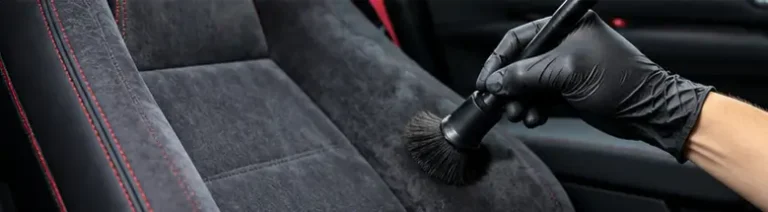
- Alcantara headliner (Rivian and some Tesla): Extremely delicate. Never saturate it with liquid. Use a dedicated Alcantara cleaner and a very lightly dampened brush. Professional handling is strongly recommended.
- Wood and ambient lighting trim: Wipe with a barely damp microfiber cloth only. Avoid solvent-based cleaners.
Our interior detailing service covers EV interior materials with specific products and techniques for each surface, from white vegan leather and Alcantara headliners to large touchscreens.
The Portland EV Angle — Why Detailing Matters More Here
Oregon is the 4th best state in the country for EV ownership. Portland’s mild, eco-conscious culture and strong state incentives make it one of the highest-density Tesla and Rivian markets in the Pacific Northwest.
But Portland’s climate creates specific challenges for EV owners:
- 140+ rainy days per year: Mineral-rich water can leave water spots on EV paint. These are particularly visible on Tesla’s softer clear coat and dark-colored Rivian vehicles.
- Portland’s heavy tree canopy: Constant exposure to tree sap, pollen, and organic debris can affect EV paint. These contaminants can bond faster to unprotected soft clear coat than to coated or harder paint.
- Frequent wet driving: Undercarriage grime, road film, and splash contamination can build up quickly, particularly behind aero wheel covers.
Ceramic coating is our most recommended EV service for Portland drivers. A professional ceramic coating service creates a hard, hydrophobic barrier over the factory clear coat. This helps reduce water spotting, allows Portland’s frequent rain to bead and roll off more easily, and makes regular washing safer and faster.
Ready to protect your EV’s paint and interior? Book your CarDetox EV detailing appointment today and our Portland-area team will give your Tesla or Rivian the specialized care it needs.
EV Detailing Frequency — How Often Should You Detail Your Electric Car?
| Service | Frequency | Why |
| Hand rinse / touchless wash | Every 1 to 2 weeks | Remove surface contamination safely |
| Full interior detail | Every 3 to 4 months | Maintain premium interior materials |
| Full exterior + interior detail | Every 3 to 4 months | Reset paint and protect surfaces |
| Ceramic coating | Every 2 years | Long-term paint protection for soft EV clear coat |
| Aero cover removal + wheel detail | Every 3 to 4 months | Prevent hidden corrosion under covers |
Frequently Asked Questions
1. Is EV detailing different from regular car detailing?
Yes. EVs have softer paint, no engine bay, frunks, glass roofs, charge ports, aero wheel covers, and large touchscreens — all of which require specific techniques and products that differ from standard gas car detailing.
2. Can you pressure wash an electric car?
Yes, EVs are designed to handle rain and normal road water exposure. However, avoid directing high-pressure jets at battery pack seams, charge ports, or sensor housings. A professional detailer knows exactly where to wash and where to be careful.
3. How do you clean a Tesla interior?
Use pH-neutral interior cleaner on vegan leather seats, ammonia-free glass cleaner on the panoramic roof, and a screen-safe dampened microfiber on the touchscreen. Never use ammonia, alcohol-based wipes, or paper towels on any interior surface.
4. Does Tesla paint need ceramic coating?
Yes, arguably more than most gas cars. Tesla’s clear coat is notably softer than many competitors, making it more susceptible to swirl marks, water spots, and paint damage. Ceramic coating adds a hard protective layer that makes Portland’s frequent rain bead off cleanly and makes every wash safer.
5. How often should I detail my electric car in Portland?
Full interior detail every 3 to 4 months. Exterior detail every 3 to 4 months. Ceramic coating every 2 years. Hand rinse or touchless wash every 1 to 2 weeks using paint-safe methods.
Sources: AAA Oregon — EV Adoption Statistics | The Weekly Driver — EV Ownership Rankings 2026